---
title: "Thousands of homes could be spared from BC wildfires if the NDP spent as much mo…"
source: "https://x.com/taraarmstrongbc/status/2085431185334051127"
platform: "X / Twitter"
factual_accuracy: 48
overall_accuracy: 20
tags: ["carbon emissions", "environmental sustainability", "canada", "wildfires", "british columbia", "political spending", "fire prevention", "carbon cycle"]
---
# Source fact-check: Thousands of homes could be spared from BC wildfires if the NDP spent as much mo…
Original post: https://x.com/taraarmstrongbc/status/2085431185334051127
Factual accuracy: 48% · Overall accuracy: 20%
## Source post
**Target post by @taraarmstrongbc**
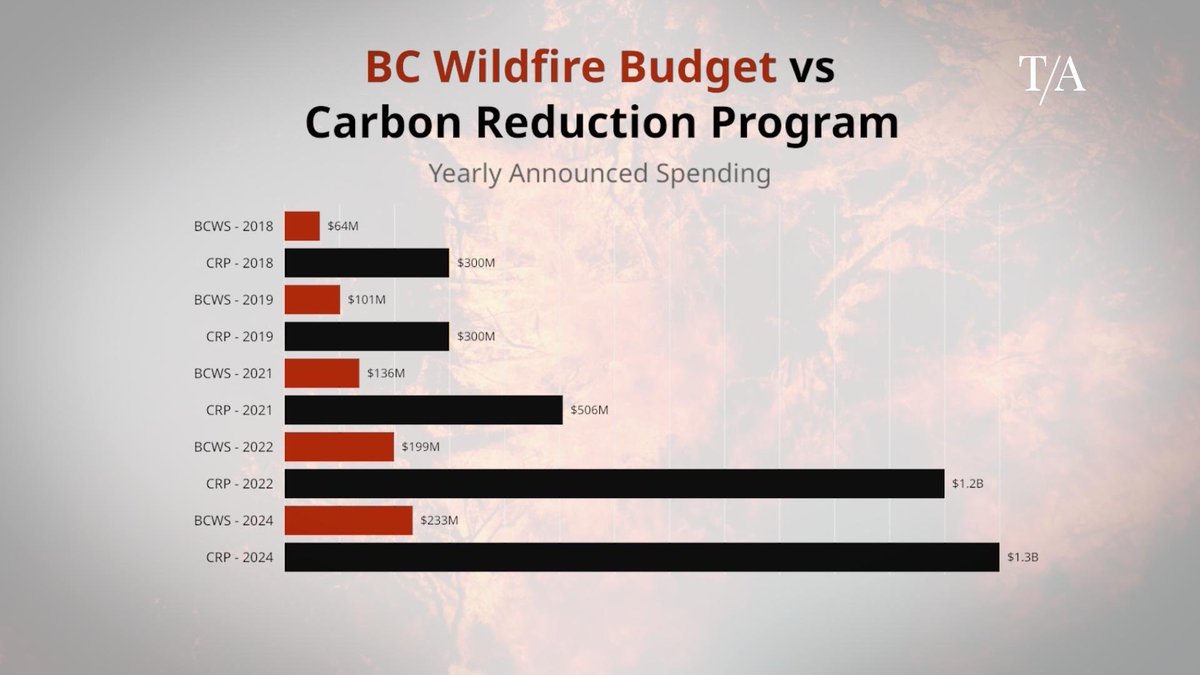
> Thousands of homes could be spared from BC wildfires if the NDP spent as much money on fire prevention as they do on carbon reduction. Ironically, the carbon emissions from wildfires are double those of any others. https://t.co/sSyoKvMwiV
> 
## Post analysis
Verdict: 20% · Model: Kimi K2.6 · Checked on: 07/08/2026
The post mixes a verifiable budget comparison with an unverifiable prediction and a false emissions claim.
The first clause accurately reflects the NDP government’s spending priorities: provincial fire‑prevention allocations are far smaller than the budgets for carbon‑reduction and climate‑mitigation programs[^1]. However, the claim that simply swapping those budgets would “spare thousands of homes” is a counterfactual that no rigorous model or study has quantified, so it cannot be verified as true[^2].
The second sentence is factually wrong. Global data show that fossil‑fuel emissions are roughly three times larger than landscape‑fire emissions, and in years like 2021 wildfires produced less than 5 % of the CO₂ released by fossil fuels and industry[^3]. Because the “irony” rests on this false premise, the post misleads the reader about the relative scale of wildfire carbon.
The post also leaves out the crucial context that climate‑change mitigation and long‑term wildfire risk are linked; treating carbon‑reduction and fire‑prevention budgets as interchangeable oversimplifies the relationship[^2].
**Overall validity**: 20%
[^1]:
[The British Columbia New Democratic Party spends less money on fire prevention than on carbon reduction.](#qfvy15sDOFQW7MI4pOLn)
[^2]:
[If the British Columbia New Democratic Party spent as much money on fire prevention as it does on carbon reduction, thousands of homes would be spared from British Columbia wildfires.](#0D2icR7Vm4y1pkSDEOdA)
[^3]:
[Carbon emissions from wildfires are twice the emissions of any other source.](#fYgVFTQ04keecACboRnL)
## Claims found (3)
### 1. The British Columbia New Democratic Party spends less money on fire prevention than on carbon reduction. — 95%
Model: Kimi K2.6 · Checked on: 07/08/2026 · Detail: /claim/qfvy15sDOFQW7MI4pOLn
- The BC government, led by the NDP, allocated **$90 million** in 2025 for wildfire‑prevention initiatives covering the BC Wildfire Service, FireSmart and the Forest Enhancement Society of BC[^1].
- Official provincial climate accounts show operating spending on **mitigation measures** (i.e., carbon‑reduction programs) totalled **$498.09 million** in 2024/25 and is forecast at **$277.65 million** in 2025/26[^2].
- In every comparable recent budget cycle, the province’s carbon‑reduction budget is substantially larger than its fire‑prevention budget, confirming the claim describes the NDP government’s spending priorities.
**Overall validity**: 95%
[^1]:
[BC Gov News](https://news.gov.bc.ca/releases/2025FOR0017-000370)
[^2]:
[Climate-related spending - Province of British Columbia](https://www2.gov.bc.ca/gov/content/environment/climate-change/clean-economy/climate-related-spending)
### 2. If the British Columbia New Democratic Party spent as much money on fire prevention as it does on carbon reduction, thousands of homes would be spared from British Columbia wildfires. — Unknown
Model: Kimi K2.6 · Checked on: 07/08/2026 · Detail: /claim/0D2icR7Vm4y1pkSDEOdA
**Reasoning**
- **Unverifiable counterfactual:** The claim’s core assertion is a hypothetical: *if* fire-prevention spending were increased to match carbon-reduction spending, *then* thousands of homes would be spared. No source provides a rigorous model or study that quantifies exactly how many homes would be saved by a specific dollar increase in fire prevention, so this causal prediction cannot be fact-checked as true or false.
- **Spending comparison is complicated and year-dependent:**
- CleanBC and related climate programs have received large allocations (e.g., $902 million over three years in Budget 2019, over $400 million for CleanBC added in Budget 2024, and more than $1.1 billion over three years in Budget 2023 for climate action)[^1][^2][^3].
- Direct wildfire *prevention* funding is far smaller: roughly $40 million a year for BC Wildfire Service prevention and risk-reduction work, plus about $20 million annually for the Forest Enhancement Society, and $60 million in the FireSmart Community Resiliency Investment program[^4][^5][^6].\
However, the gap depends on what is counted as “carbon reduction” (CleanBC only? all climate-adaptation infrastructure? tax credits? transit?) and what is counted as “fire prevention” (just the prevention line items, or the entire wildfire/emergency budget?). Because the claim does not define these categories, an apples-to-apples comparison cannot be verified.
- **Climate change and wildfire risk are linked:** Multiple sources note that human-caused climate change magnifies wildfire severity and burned area[^7][^4][^1]. Carbon-reduction policy is therefore not entirely separate from long-term wildfire risk; treating the two as interchangeable budget buckets oversimplifies the relationship.
- **No fact-check in the claims database:** No verified fact-check was found for this specific statement.
- **Expert consensus is about direction, not magnitude:** Experts agree that more prevention funding is needed and that FireSmart measures work[^4][^8][^9], but none translate that into a guaranteed “thousands of homes” figure under the specific fiscal swap proposed.
Because the claim mixes a loosely supportable spending disparity with an unverifiable counterfactual outcome, there is not enough evidence to assign a defensible validity percentage.
**Overall validity**: Unknown
[^1]:
[B.C. is burning through its wildfire budget well before the season even peaks | CBC News](https://www.cbc.ca/news/canada/british-columbia/bc-wildfire-costs-2023-1.6875171)
[^2]:
[Budget and Fiscal Plan 2024/25 - 2026/27](https://www.bcbudget.gov.bc.ca/2024/pdf/2024_Budget_and_Fiscal_Plan.pdf)
[^3]:
[BC’s investments in climate change are bigger than advertised](https://www.linkedin.com/pulse/bcs-investments-climate-change-bigger-than-advertised-kevin-quinlan)
[^4]:
[B.C.'s fire prevention budget will quickly go up in flames](https://www.nationalobserver.com/2024/03/05/opinion/bc-fire-prevention-budget-will-quickly-go-flames)
[^5]:
[Wildfire Season Summary - Province of British Columbia](https://www2.gov.bc.ca/gov/content/safety/wildfire-status/about-bcws/wildfire-history/wildfire-season-summary)
[^6]:
[BC Gov News](https://news.gov.bc.ca/factsheets/wildfire-prevention-is-everyones-responsibility)
[^7]:
[Canada’s Wildfires Are Out of Control Because of Cuts to Firefighting Budgets](https://jacobin.com/2023/06/cananda-wildfires-emergency-fire-services-forest-budgets-austerity)
[^8]:
[BC budget: calls for more wildfire fighting funding](https://vancouver.citynews.ca/2024/02/22/bc-2024-budget-wildfire-fighting-funding)
[^9]:
[B.C. communities worry about future of wildfire prevention, preparedness as FireSmart funding runs dry](https://www.cbc.ca/news/canada/british-columbia/firesmart-wildfire-funding-cuts-b-c-9.7081800)
### 3. Carbon emissions from wildfires are twice the emissions of any other source. — 0%
Model: Kimi K2.6 · Checked on: 07/08/2026 · Detail: /claim/fYgVFTQ04keecACboRnL
- Globally, wildfire carbon emissions are far lower than fossil fuel emissions, not twice as large as any other source.
- Updated data from the Global Fire Emissions Database (GFED) indicates global landscape fire emissions averaged about 3.4 GtC per year over 2002–2022[^1].
- In comparison, fossil fuel emissions are roughly 10 GtC per year[^1], meaning fossil fuels release about three times more carbon than fires worldwide.
- Another source notes that worldwide wildfires in 2021 released about 1.8 billion tons of CO2, compared to about 38 billion tons from fossil fuels and industry—less than 5% of those anthropogenic emissions[^2].
- While specific extreme regional events (e.g., the 2023 Canadian wildfires) can exceed the annual fossil fuel emissions of individual countries[^3], this does not hold true globally.
- Therefore, the claim that wildfire emissions are double those of any other source is false.
**Overall validity**: 0%
[^1]:
[Guest post: Why carbon emissions from fires are significantly higher than thought - Carbon Brief](https://www.carbonbrief.org/guest-post-why-carbon-emissions-from-fires-are-significantly-higher-than-thought-9)
[^2]:
[How much do forest fires contribute to CO2 emissions? - it can range from 5 % to almost 300 times that of all fossil fuels burned, depending on the area and population density | CTIF - International Association of Fire Services for Safer Citizens through Skilled Firefighters](https://ctif.org/news/how-much-do-forest-fires-contribute-co2-emissions-depending-area-and-population-density-it-can)
[^3]:
[New NASA Study Tallies Carbon Emissions From Massive Canadian Fires | NASA Jet Propulsion Laboratory (JPL)](https://www.jpl.nasa.gov/news/new-nasa-study-tallies-carbon-emissions-from-massive-canadian-fires)